Be it from San Martín or Junín de los Andes, the road winds along changing landscapes ranging from the steppe to the Andean Patagonian forest before reaching Puerto Canoa, on Lake Huechulafquen, the starting point of a spectacular outing on the José Julián. It was a warm, sunny day when we boarded the catamaran. Once we were comfortably seated in the cabin, Leonor, our guide pointed out the privilege of sailing in a restricted, almost intangible area of the national park. As soon as we had left the port behind we went up on deck to take in the magnificent landscape all around us. While the wind blew in our faces, our first surprise was a close up view of the Lanín Volcano. This cone shaped, glaciated giant is the highest in the area. Heading south, we found ourselves facing mounts Cantala and Los Angeles as well as Isla de los Chivos. Here and there poplar groves stood out among the motley woods signaling the presence of settlers. The water of this incredible glacial lake takes on different hues of green, turquoise or blue according to the angle of the sunrays.
Huechulafquen Lake Outing
-
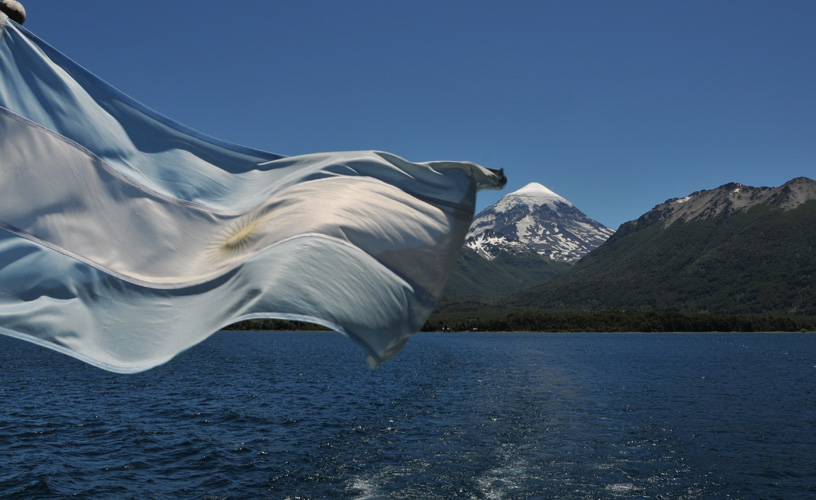
The southern side of the Lanín Volcano
-
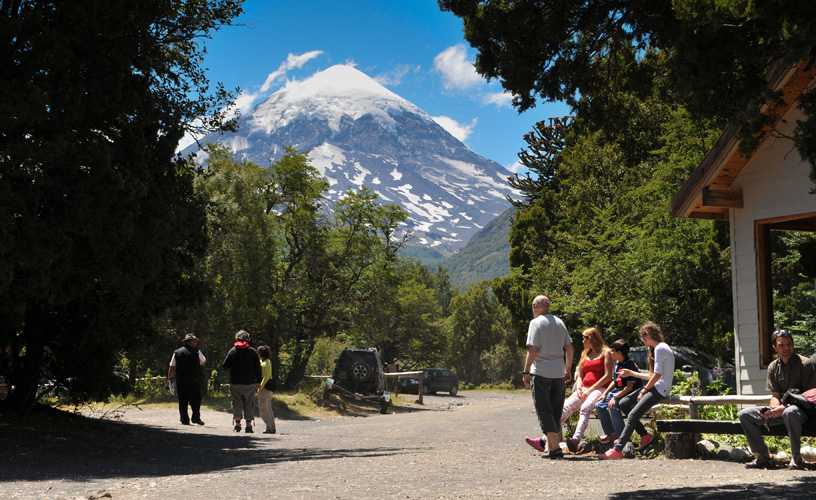
Puerto Canoa
-
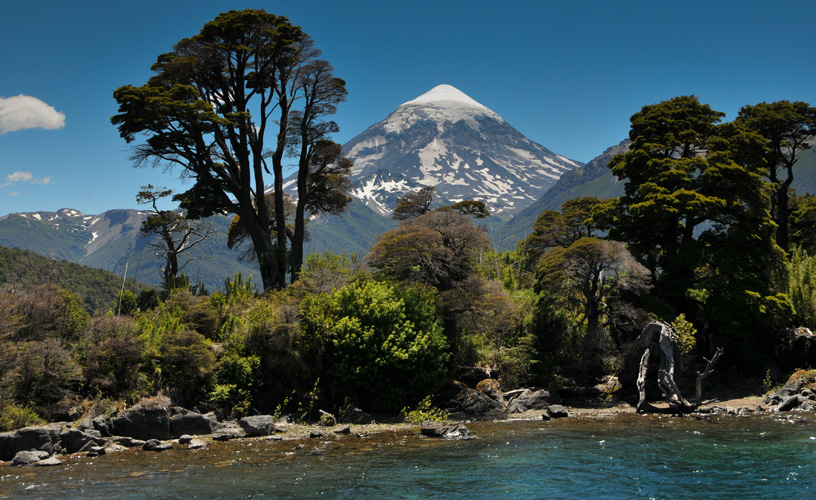
A feeling of smallness invaded us
-
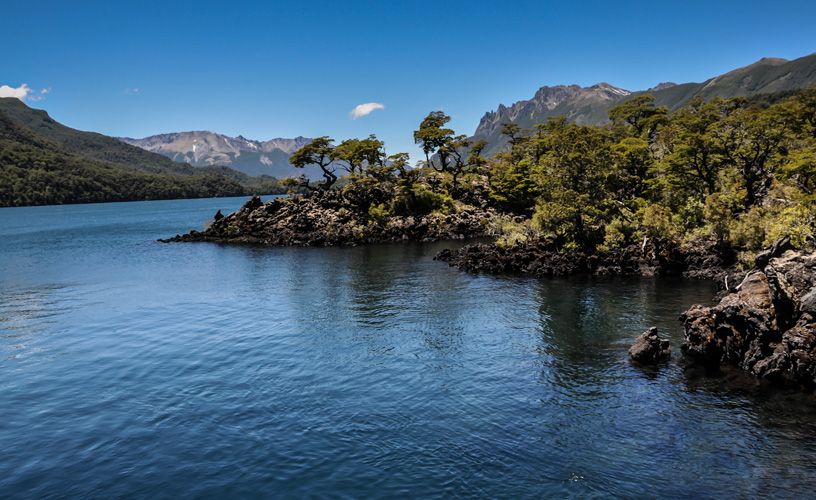
El Escorial
-
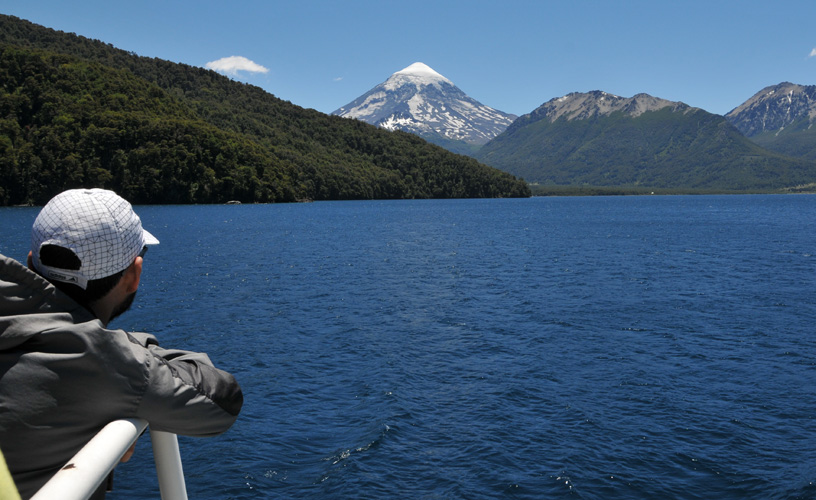
Captivated by the scenery
-
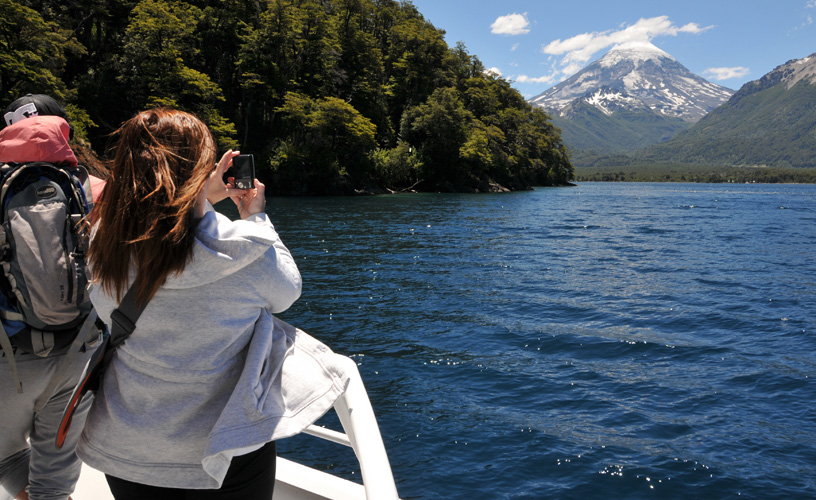
Silent witnesses to the untouched nature
-
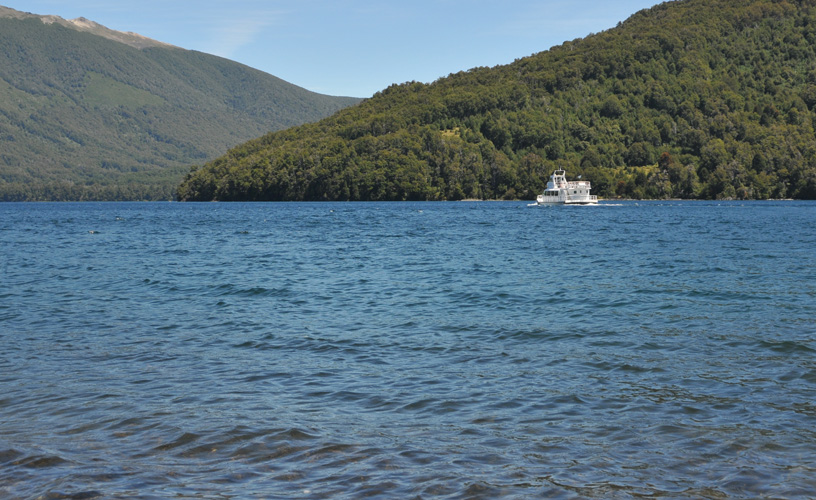
Lake Huechulafquen
To get to Lake Epulafquen, we sailed along a shallow narrows. We could clearly see some fallen branches on the rocky bottom. Bays and gravel or volcanic ash beaches unfolded before our eyes framed by the mountain slopes, covered by high native coihues competing for sunlight. We sailed past an old, abandoned pier and a building which was once a park warden station. We kept on enjoying the view while savoring a delicious coffee and cookies. We learned about nature, the environment and especially the causes of the changes in this part of our planet from Leonor, our guide. She also told us about fishing and the different species found in these lakes before preparing us for what would ensue. Our next surprise was woodlands with bonsai-like vegetation on the south coast of Lake Epulafquen. They are the post-volcanic consequence of a 400-year-old event when a river of lava from Achen Niyeu burned everything in its path all the way down to the coast of the lake. The catamaran sailed into a small bay and stopped a meter off the coast so we could easily see the black rocks and twisted cypress and coihue tree trunks as well as some green moss patches, the building blocks of the soil. Leonor pointed out that a new forest, as high as existing ones will, in time, stand. When the boat turned to head back to port, we had a better view of El Escorial, the black, rocky lava bed. Leonor mentioned another process related to volcanism: Lahuencó or Epulafquen hot springs close to the border with Chile, which can only be reached by land in summer. Each geographical feature has its meaning, history or legend besides its unique, unforgettable beauty. Before disembarking our guide quoted from Historias Naturales a book by Jules Renard: “Nature entertains the common man, teaches its disciples but only reveals its secrets to the wise.” A really appropriate farewell for an unforgettable outing.
 Mónica Pons
  Eduardo Epifanio
Contact of the excursion or tour
Catamarán José Julián
Av. San Martín 881 Loc.6, Junín de los Andes, Neuquén, Argentina
 Cell Phone: +54 2944-317402
 Level of Difficulty: Low.
 Duration: Navigation takes 90 minutes approximately.
 Outings throughout the year. Timetable changes for summer and winter seasons.
 Twitter X
 WhatsApp
 Facebook
 E-mail
 Copy Link