| |
|
Estimated reading time: 5 min. |
M. Sola y S. Gaudio Santiago Gaudio |
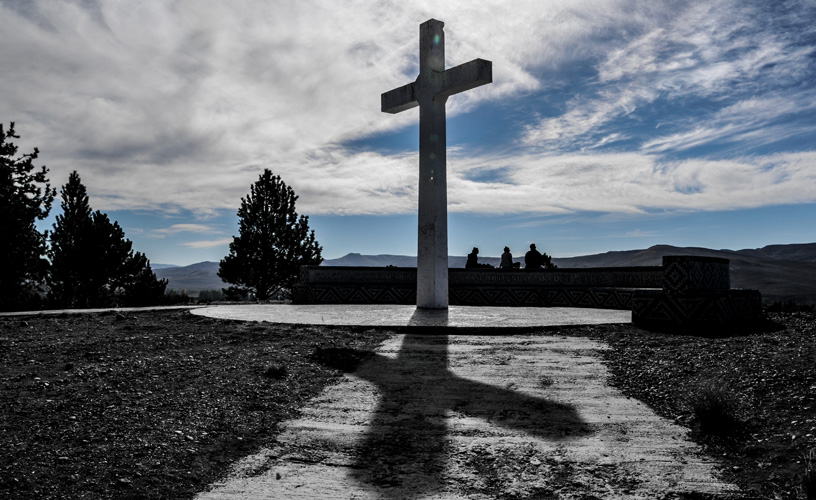
This undertaking is an impressive work, fruit of the joint labor done by various areas of the Junín de los Andes community.
In this quiet spot, there are eighteen stations that give visitors the possibility of praying and practicing their religion in a landscaped setting recreated for such purpose.
This result of the combnation of the Mapuche and the Christian cultures occupies a 2-kilometer route, starting at Antártida Argentina Street and the mountain. It contains impressive images which transmit a strong message of faith and hope. |
|
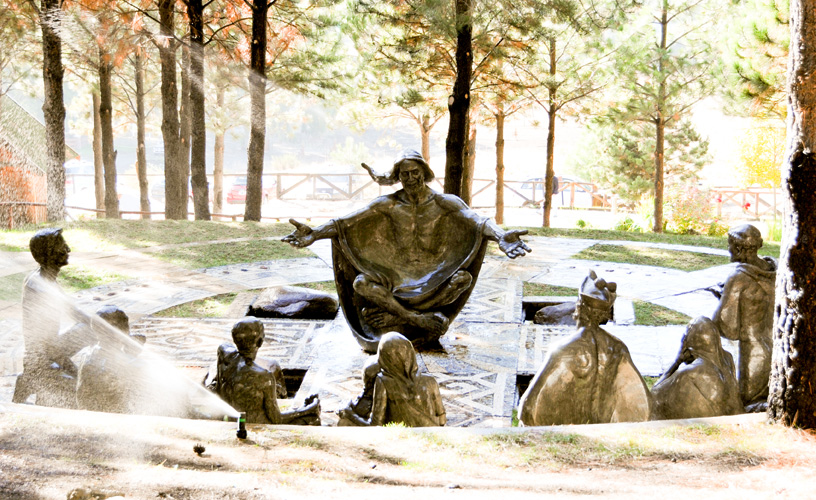
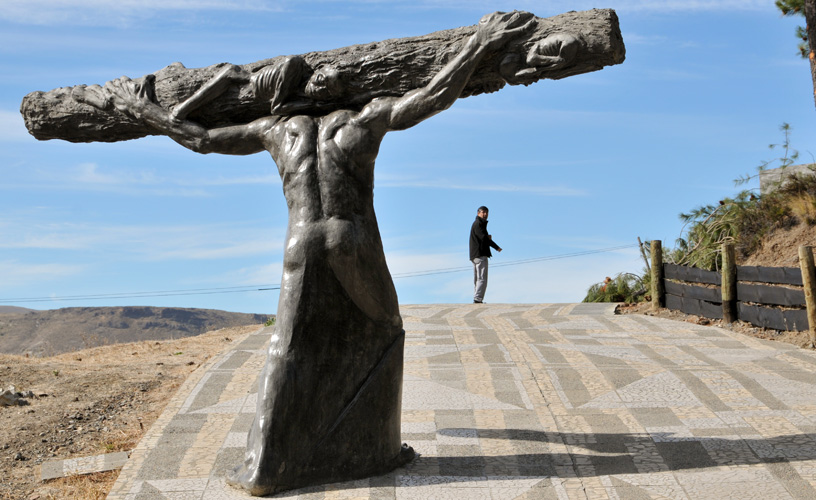
The various stations are dry squares with a 12-meter diameter and represent the sun. The handmade ornamental statues in each of them represent images of pre-Columbian cultures. In each station, two embossed wooden plates reflect a paralellism between Christ's life, the Church, the Mapuche people and their saints, and they provide the necessary information for their interpretation. |
 |
Stations of the Via Christi Walk
Station 1. “Jesus is born” Inspired in the biblical text of John 1, 14.
"The Word became flesh, and lived among us. We saw his glory, such glory as of the one and only Son of the Father, full of grace and truth."
Child Jesus is picked up by Mary and Joseph. According to Santana: “in this first station there lies the key to interpret the entire Via Christi, as it is here where He became a man and he did so within a certain culture. And if that has happened, it means that each culture may also reinterpret, describe and give a new shape to the mystery of His presence in order to get us closer to the mystery of our own reality”. |
 |
The characters in this sculpture represent several cultures: the Hispanic, the Mapuches and the mixture of races, the various communities that have been reached by God’s hand.
Station 2. “Jesus and the Beatitudes” Inspired in the biblical text of Matthew 5, 1-12
“Seeing the multitudes, he went up onto the mountain. When he had sat down, his disciples came to him. He opened his mouth and taught them, saying: ‘Blessed are the poor in spirit, for theirs is the Kingdom of Heaven’” |
 |
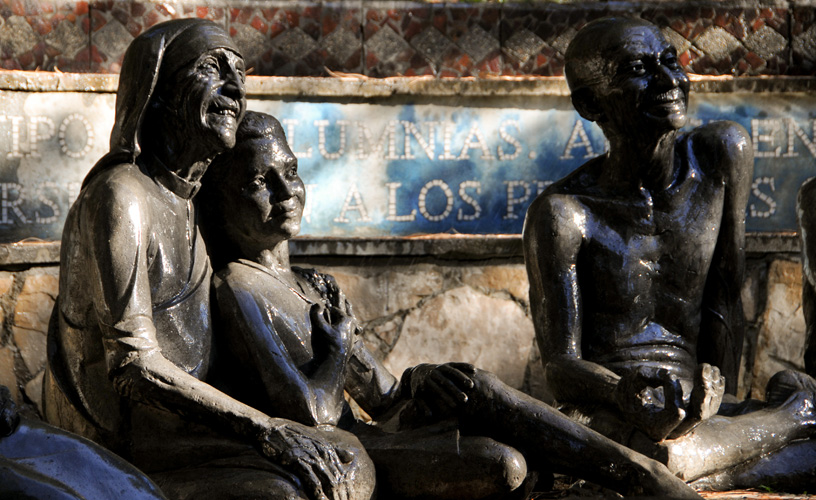
We find Christ surrounded by eight celebrities who have left their track for mankind due to their behavior and devotion to noble causes. Among them, the artist shows Saint Francis of Assisi, the mothers of pain, Martin Luther King, “Patirú” Domingo Milanesio, Mother Teresa, Laura Vicuña, Gandhi and Father Carlos Mugica.
Station 3. “Jesus and the Children” Inspired in the biblical text of Mark 10, 13-22
“Allow the little children to come to me! Don't forbid them, for the Kingdom of God belongs to such as these. Most assuredly I tell you, whoever will not receive the Kingdom of God like a little child, he will in no way enter into it.” |
 |
Jesus holding 4 children, a simple fatherly image in which the author wishes to express a daily situation, filled with the love of God for His children. Faces with smiles and expressions of tenderness outstand at this station.
At the foot of the image we notice the presence of a little lamb that represents the love of the Good Shepherd.
Station 4. “The Prodigal Son” Inspired in the biblical text of Luke 15, 11-24:
“… let us eat, and celebrate; for this, my son, was dead, and is alive again. He was lost, and is found…” |
 |
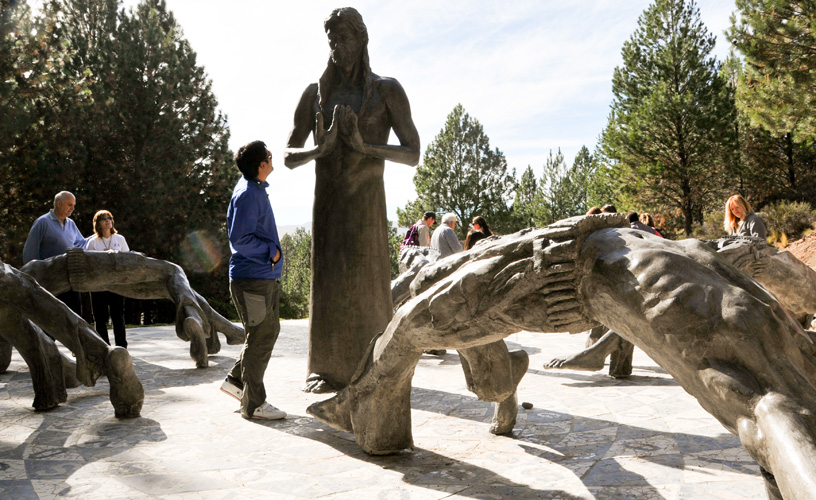
In the center of this labyrinth-shaped square, we find a father embracing his son. It is a merciful, powerful and strong father. In this embrace, we see that the father has a feminine hand. We have the idea of the Father as a man, but Creation shows that nature is both masculine and feminine in procreation. He is the father and the mother at the same time.
The child represents mankind, with its defects, errors and later reflections and regrets. The labyrinth always leads to the center, a path that leads to the Father.
Station 5. “Jesus Heals the Man with the Withered Hand” Inspired in the biblical text of Mark 3, 1-6:
“He said to the man who had his hand withered, ‘Stand up’. He said to them, ‘Is it lawful on the Sabbath day to do well, or to do harm? … When he had looked around at them with anger, being grieved at the hardening of their hearts, he said to the man, "Stretch out your hand." He stretched it out, and his hand was restored as healthy as the other. The Pharisees went out, and immediately conspired with the Herodians against him, how they might destroy him.” |
 |
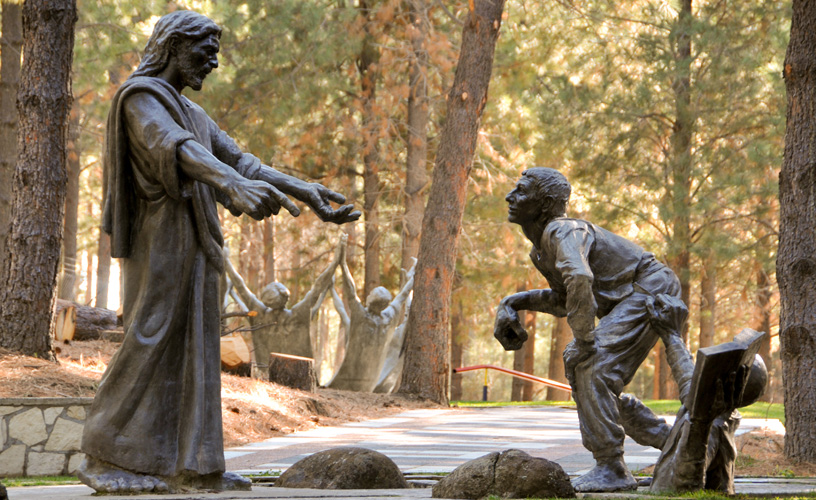
In this figure, Santana makes a parallelism between what God told the Jews of those days with things that happen in modern Argentina. He wishes to show that the word of God is present and that the message is not lost.
The image shows an unemployed individual, with his withered hand. He is paralyzed because he has no possibility of working. This man, in turn, is being trapped by a blind economist (who looks very much like the former minister of economy Domingo Cavallo) who is pulling him down.
In this situation, we find God asking: “What is more important? This man or the law?”
Station 6. “Jesus Feeds the Crowd” Inspired in the biblical text of Mark 6, 35-44:
“He took the five loaves and the two fish, and looking up to heaven, he blessed and broke the loaves, and they all ate, and were filled.” |
 |
At this spot, we find Christ and a child standing on a pattern of bread and fish that rise up to God’s hand, thus generating the concept of the infinite.
The child represents purity, resigning everything he has and giving it to the Lord to be multiplied.
Station 7. “Jesus Washes His Friends’ Feet” Inspired in the biblical text of Mark John 13, 2-20:
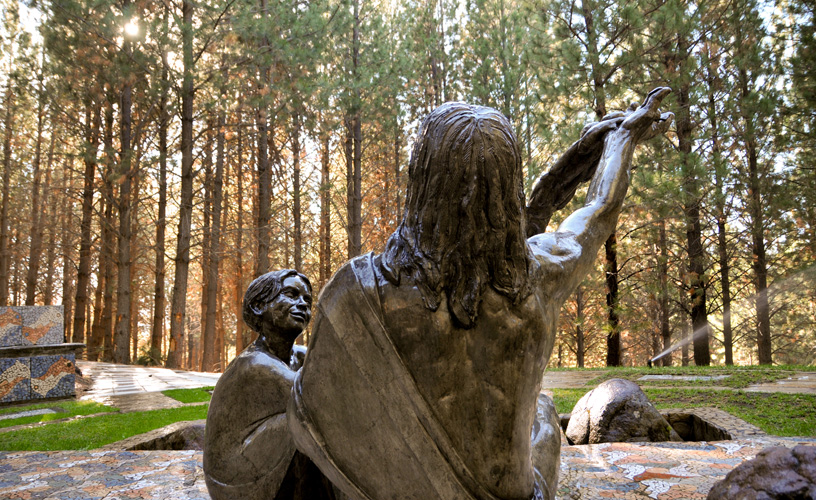
“If I then, the Lord and the Teacher, have washed your feet, you also ought to wash one another's feet.” |
|
 |


 |


Here are the most important aims of the creation of the Via Christi Walk:
1. Announce Jesus' good news.
2. Rescue the presence of Blessed Laura Vicuña, former student at the María Auxiliadora, who lived and died in the district, and of Ceferino Namuncurá, also former Salesian student from these lands whose family still lives in the outskirts, as models for adolescents, youths and adults who wish to follow Jesus Christ.
3. Revaluate Latin American, Argentinian history and the history of Neuquén; especially the crossbreeding produced by the encounter of various cultural sources.
4. Incorporate the gospel to the various local cultures, especially the Mapuche culture.
5. Strengthen the encounter of people, as Junín de los Andes has always been a place of encounters for original communities. At present, 14 Mapuche communities reside here.
6. Create new spaces for the people to encounter the extraordinary magnificence of nature in the lakes, the Lanín Volcano (sacred place), the forests, the flora and fauna.
7. Foster religious tourism.
Via Christi Walk Group |

 |

|
 |