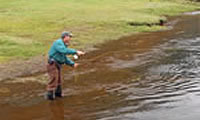
In order to fish in the Patagonian rivers, it is necessary to learn how to read these waters. And this is managed by understanding each of the geographical features shown by the water courses as we walk or wade.
There is a piece of advice the most experienced fly-fishermen or anglers usually give: we should not forget that the surface of a river is an immediate result of what happens at the bottom. In consequence, when we look at what happens on top of the water, we can interpret what is happening underneath.
This is the essential secret to “read the waters” rightly.
Flume
It is the shallowest part of the river, where the water runs faster and, therefore, is more oxygenated. There are slow and fast flumes, with or without white waters, lying on against one bank or in the middle of the river, short, deep, lower, as the anteroom or exit of a large pool. All of them grant possibilities for the fly-fisherman, but the best opportunities of catching large brown trout are present in the deepest ones.
Countless insects shelter from predators and the strength of the current among the rocks that form the riverbed. Therefore, the trout travel all along and across the flume environments.
Run
It is much deeper than the flume and its waters run a little bit more slowly.
Headwaters
It is a site where the flume empties its waters into a natural canal that gives shape to the river. Here the trout have a large flow of food and the headwaters offer very good shelter, as well as oxygen.
Water Joint
It is the separation line between two water streams that flow parallel along the river at different speeds. The fastest current is the one bringing better food, more oxygen and commonly known as the “dirty line of the river”, as it drags insects as well as everything that falls into the water.
Obstacles
They could be represented by large rocks, a log lying across the river or a tree that has fallen down. They are elements that interrupt the stream and create natural privileged sites for trout to stay and wait for the passing of insects.
Bends
In the points where the river presents its typical bends, the strength of the stream added to the centrifugal force of the water dig up a deep gutter near the coast. Due to the action of the water, the external part of the bend will turn out to be the deepest part, with the fastest stream and, therefore, the one transporting the largest amount of oxygen and food. As a result, it will contain more and better trout.
Pool exit
It is also known as “the flat”. It is the stretch of the river following the pool, in its final end. It is called the pool tail. The height of its bed decreases rapidly and its speed goes up until it reaches that of the flume. It is as deep as a flume but its surface is flat, reflection of an even bed without great depressions, formed by small rocks, sand or mud.
The pool
When in the summer season (January and February) the rivers have scarce volume of water or are low, the trout look for protection in safer and deeper sites. Thus, they leave the famous flumes and flats and shelter in the pools located along the river.
There they meet the larger trout that live permanently in those sites, as they would be easily seen in shallow waters. They only leave their home in search for food when the light makes them harder to detect, that is to say, at sunset or dawn. There is a reason for the best specimens, both brown and rainbow, to be caught very early or very late in the day.