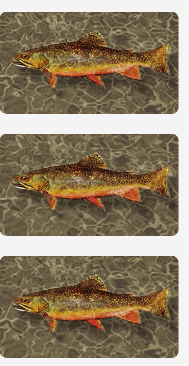
Una especie de gran belleza y voracidad que cambia su coloración como consecuencia de la alimentación. Es marrón verdosa por momentos iridiscente, con motas claras y rojas en su lomo y parte superior de la cabeza; el vientre es blanco rosado.
Por el característico color de su carne rosada, mereció el bautismo de trucha salmonada y la denominación de salmón.
Debido a que prefiere aguas más frías y bien oxigenadas, su distribución se halla más restringida con respecto a las otras truchas, encontrándose mejor representada hacia el oeste de la provincia del Neuquén, en ambientes precordilleranos y cordilleranos.
En cuanto a su tamaño, es el menor de los salmónidos de Neuquén, sobrepasando los 4 kg sólo en raras ocasiones, en ambientes lacustres.
Época de captura: toda la temporada.
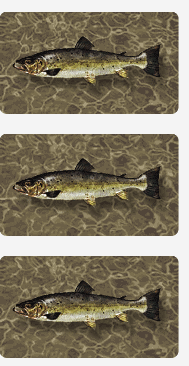
Oriundo del lago Sebago, si bien fue introducido a principios del siglo XX en numerosos ambientes, hoy en día sólo es posible encontrarlo en unos pocos.
Es plateado, con el dorso y la cabeza azulada, manchas negras sobre los flancos y aletas dorsales oscuras, con franjas azules.
El término de “encerrado” hace referencia a su comportamiento en aguas dulces, ya que en sistemas hídricos próximos al mar, esta especie alterna entre los dos tipos de agua (salada y dulce), en distintos momentos de su vida.
Es fácil confundirlo con la trucha marrón, de la que se distingue por su boca más chica, ya que el maxilar no supera generalmente el borde posterior del ojo.
Época de captura: toda la temporada.
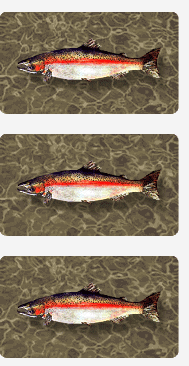
De cabeza pequeña y cuerpo alargado, posee dos aletas dorsales, siendo una de ellas (la más pequeña) de tejido adiposo exclusivamente.
Su color es vistoso, azulado o verdoso hacia los flancos y un blanco plateado en su vientre; en la mitad de sus laterales tiene una franja longitudinal roja púrpura o rojiza más notable. Esta coloración, si bien es típica de la especie, puede variar de una trucha a otra hasta desaparecer en algunas, las que son comúnmente llamadas "plateadas".
Existe además una variabilidad importante en cuanto al color en relación a la cercanía de la época de desove, siendo más oscuros y pigmentados los especímenes maduros.
Todo su cuerpo está salpicado por pequeñas manchas oscuras, las que se extienden a su cola y aletas.
Es posible encontrarla en casi todos los ríos y lagos de la provincia de Neuquén, siendo muy codiciada por los pescadores por su combatividad y tamaño, ya que puede superar los 10 kg en ambientes lacustres. Se alimenta de insectos, moluscos, crustáceos y peces.
Época de captura: toda la temporada.
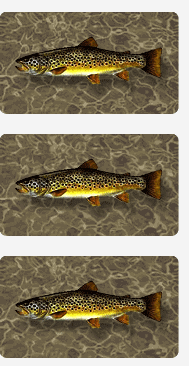
Es, quizás, el salmónido más popular entre los pescadores deportivos, debido a que vive en ambientes poco accesibles, donde a veces es difícil llegar con un señuelo, sumándose a esto, sus características de modalidad esquiva, impredecible, agresiva y enormemente astuta, que la hacen difícil de engañar, configurando su captura como un hecho realmente especial.
Su color en los ríos es marrón más oscuro en el lomo, hacia los flancos un marrón dorado y remata en su región abdominal, con un color blanco amarillento. Tiene manchas repartidas en su cuerpo, en la parte superior son verdes o marrones y en los costados se mezclan con pintas rojas envueltas en círculos pálidos.
Se la encuentra en gran cantidad de ambientes y es la trucha que alcanza mayor tamaño (alrededor de 15 kg). Se alimenta de insectos acuáticos y terrestres (estados larvales y adultos), crustáceos y los ejemplares adultos son grandes consumidores de peces.
Época de captura: toda la temporada.
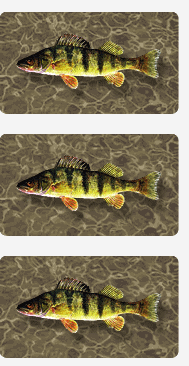
Existen tres especies de percas, a saber: perca boca chica, perca bocona y perquina espinuda. Como característica principal presenta una sola aleta dorsal con los primeros radios transformados en espinas fuertes y punzantes.
Posee boca protráctil, aletas ventrales y el dorso de color oliváceo, aclarándose en los flancos y con el vientre cremoso.
Se encuentra en numerosos ambientes de la provincia, y es la única especie que no ha sido introducida por el hombre. La especie bocona puede superar en algunos casos los 4 kg.
Época de captura: toda la temporada.
• La temperatura óptima para engordar y crecer está entre 13 y 21 grados centígrados ( 56 a 70 F).
• La cantidad mínima de oxígeno saturado en el agua que requiere para sobrevivir es de 5 a 6 partes por millón. Normalmente debe tener de 9 a 11 ppm que es casi la saturación total (14 ppm).
• La alcalinidad (PH) es otro factor importante, pues fuera de los rangos 7 y 8 que son los adecuados, como ser PH 6, no se reproduce por ser demasiado ácido el ambiente.
• Las truchas son sensibles al color. Las truchas marrones y las arco iris, perciben rangos de absorción de la luz en el espectro que son completamente invisibles a nosotros (350 nanómetros {350 x10e-9m}).