There is a famous popular saying in Spanish that goes “There is a reason for the river to roar”. And when people talk about the Chimehuín River, there is a reason for that too. Not in vain have many anglers from all round the world christened it as the most beautiful river in the world.
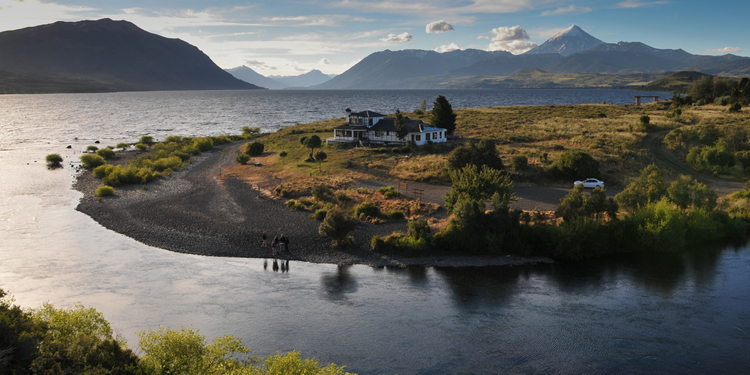
January and February are special months for fishing in the Argentinian Patagonia, when the temperature rises during the first hours of the day and water from most courses becomes scarce. Thus, it becomes easier to find out pools and flumes, ideal for beginners.
Therefore, when Darío Damonte suggested that we go floating on the Chimehuín River from down the Devil’s Throat up to the bridge in Route 234, I did not hesitate to say “yes”.
Darío and Héctor, his father, picked us up at the Quinen Inn, in San Martín de los Andes, to take us to the fishery. Among jokes, anecdotes and country music, we slowly traveled the rubble road that leads to the mouth of Lake Huechulafquen.
Without crossing the river bridge, we turned right into a dirt path that heads for the fisheries. Once there, Héctor helped us get the raft down and wished us good luck. At 7.30pm, he would be waiting for us at a few meters from the Route 234 Bridge, in the access to the small and picturesque Junín de los Andes.
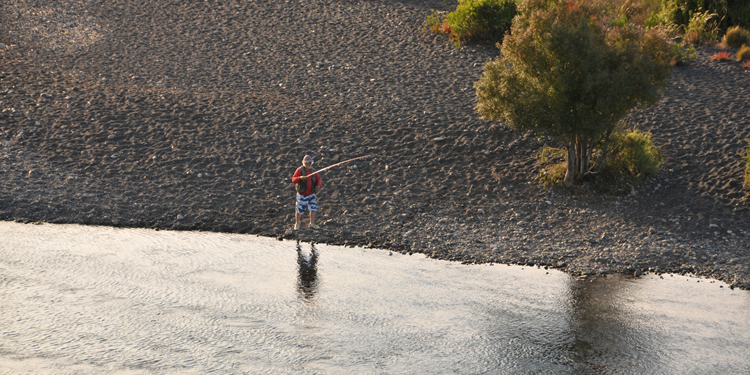
We took the raft down. The weather was ideal. It was not yet 9 in the morning and we were already stepping into the cold waters.
Darío would row and lead the raft, while Emiliano and I began to cast towards both banks.
The sites and fisheries we were leaving behind were beautiful indeed, with their transparent waters that allowed us to see fascinating rock beds and sand bank edges at first sight.
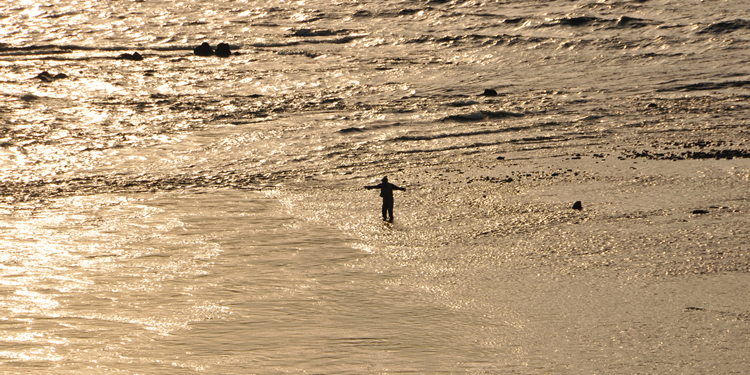
The Chimehuín is the river of streamers and it is the large brown trout’s job to confirm it regularly, with catches that generally surpass the 3 kilograms.
After sailing along some flumes, the first stop was reached. The boat approached one of the banks and remained at a casting distance from a beautiful blue-water flume. Darío set his fly perfectly and as he would slowly pick up his fly, a large fish would jump over it, but it did not get hooked. We fished for a while and thus we tried all the flumes and pools we were passing by.
The formation of large stones causes the river to have real falls, therefore, natural rafting turns out to be an addition to the attractions experimented by the angler.
We arrived in the famous Piedra del Viento (Stone of the Wind), a beautiful rock formation in brown, grey, red and black, eroded by the wind and the tides.
Darío would point at the spots where the trout could be. That is how the largest trout were in the shallowest sites. My fly fell next to an old willow, by the riverbank, where the river was not even twenty centimeters deep, and the trout immediately took the streamer. The brown trout, which would loosely surpass the one and a half kilo, would fight for freedom at the other end of the line.
The ritual of food is something the angler can fall in love with. Darío knows it well. Once on solid ground, the clock would strike 12 and an excellent Patagonian snack was expecting us. Wine, beer and soda would anticipate the main course of the day: barbecued chicken cooked in the fishing site. As the chicken was getting browner, we continued fishing, this time from the shore, in a place resembling paradise.
After the siesta hours, we continued fishing in the raft. The area known as “La herradura” (the horseshoe) is really amazing and sometimes you can see trout weighing over 5 kilos there.
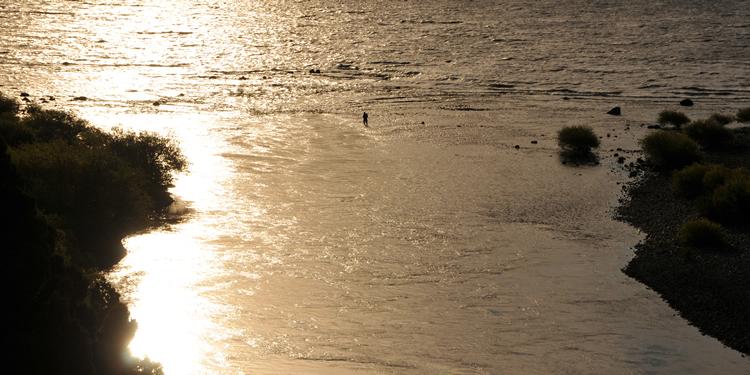
After passing by the area of the CEAN - Centro de Ecología Aplicada del Neuquén (Neuquén Center of Applied Ecology), where the river treasures some flumes and pools of an incredible green, we stopped fishing. Eventually, at 7.30pm, we arrived in a nook of the river where Héctor was waiting for us with the trailer to pick up the raft and go back to San Martín de los Andes.
We enjoyed a spectacular day and indulged ourselves with almost twenty bites, catching some really beautiful specimens that we released back into the water safe and sound.
And so, the “Chime”, like we all call it: a river from out of this world, which thank God is Argentinian. With magical waters, amazing scenery and an ancient volcano keeping watch on it and, of course, packed with brown and rainbow trout which, due to their size, can drive more than one angler crazy.
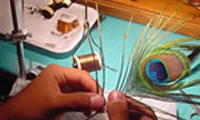
How do you fish when there is no fishing? How do you enjoy a passion when you have to wait for months? How do you keep yourself from going mad while you wait?
The Season is Over
Fishing trout and salmonida in Argentinian and Chilean Patagonia is pure magic. It is hard to put it into words without feeling touched and nostalgic about the old days, the old friends, the old memories and the mythological fish we have come across in our lives.
This beautiful madness starts every year early in November, both in rivers and lakes, until May 31, when the season is closed to protect the species.
When this happens, fly-fishermen begin to migrate towards other environments where we have the possibility of fighting a duel with other species of significant sport value, such as the dorado, the tararira or even the pejerrey, but Patagonia has to wait until the following year.
Who Has Been Here?
It is in these moments that the fishermen go in search of their fishing box and start to watch that something has happened. That incredible fly made of green pheasant feathers with violet and yellow shades which had been the perfect streamer during the season is no longer here. “There are no more dry flies left, dad” was the phrase that made us aware of the truth: the season has left unforgettable trout but it has also taken away unforgettable flies.
And when it comes to the nymphs, those flies that can fish when no one can fish, those weird flies that imitate practically unrepeatable larva states, they always work at the time of catching fish if well-manipulated in the water.
When this happens, we realize that the season is over and that we have to continue fishing indoors in order to be ready by November 1.
Fly-Tying Has Begun
In the XX century, mass-production has shown the world that everything could be made in large scale. This represented progress in many ways, but it was also disappointing. Hand work and craft were replaced by large machines that did in a couple of minutes what men took hours to finish.
Fishing could not escape disappointment. However, beyond the rods, the reels and the lines, fly-tying continues to be under man’s domain. There may be thousands and thousands of flies all over the world, but all of them have been tied by different men: apprentices, amateurs, professionals or craftsmen who have learned the technique or had the skilled to do it. But they all had to tie them themselves.
This ritual starts when the fishing season is over and it is repeated at each club and association where thousands of fly-fishermen continue to gather in order to learn more about this sport.
It is Best to Have your Own
Even if there are many fishermen who prefer to buy them at the market, tying flies is a pleasant practice itself. Beyond the patience each angler may have, the fact of hanging out with friends searching for the perfect fly has its own motivations.
Each fly has its own tying technique and a certain choice of materials. It is necessary to acquire experience by watching others in order to understand when a fly is well tied and when it is not.
The satisfaction reached by an angler when their own fly manages to catch a fish is indescribable. It is the very essence and the spirit of this wonderful activity called fly-fishing which generates passion and fanatism, even out of season.