On the Chilean side, the southern Pacific has a different character: fishing coves, forest reaching almost to the sea, colonial-era forts and, on Chiloé, a wild coast where penguins, sea lions and otters live.
This route runs north to south: the coast of Valdivia, that of Osorno, the surroundings of Puerto Montt and the Isla Grande de Chiloé.
The route
From Valdivia, Route T-350 leads to Niebla, and from there the coast continues north. From Osorno, Route U-40 runs down to the coast of San Juan de la Costa. Further south, the Pan-American Highway crosses to Chiloé over the Chacao Channel and ends in Quellón.
Stops
Niebla, Los Molinos and Curiñanco (Valdivia coast)
Niebla, at the mouth of the Valdivia River, 17 km from the city, is the area’s main beach resort, with three beaches (Playa Chica, Playa Grande and Playa de los Enamorados), seafood restaurants and the Castillo de Niebla, one of the forts Spain built in the 17th century to defend the estuary. A ferry crosses to Corral.
To the north, Los Molinos has one of the few beaches on the Valdivia coast suitable for swimming, an artisanal fishing cove and a traditional fair with seafood; its high season runs from 15 December to 15 March. The coast continues with San Ignacio, Playa Rosada, La Misión, Calfuco and Curiñanco, which borders the Punta Curiñanco Protected Coastal Area. The Expreso a la Costa bus links Valdivia with all these beaches.

Playa Grande in Niebla, Valdivia. Foto: Lin linao · CC BY-SA 4.0 · Wikimedia Commons

The Castillo de Niebla, facing the Valdivia River estuary. Foto: Carlos Figueroa Rojas · CC BY-SA 4.0 · Wikimedia Commons
Maicolpué (Osorno coast)
A bay and beach resort in the municipality of San Juan de la Costa, 65 km from Osorno on a paved road (Route U-40). Its name comes from Mapudungun and means “place where there are dove feathers”.
Pelluco (Puerto Montt)
A beach resort 4 km from Puerto Montt, on the road that connects with the Carretera Austral. In Mapudungun, its name refers to the choro, a mussel.
Maullín and Carelmapu
Maullín, between the Pacific and the Chacao Channel, has wetlands where 94 species of waterbirds have been recorded; since 2016 they have been part of the Western Hemisphere Shorebird Reserve Network. Southern river otters (huillines), an endangered species, live in the river. Carelmapu, founded in the 17th century, is known for its huge festival of the Virgen de la Candelaria.

The church in Carelmapu. Foto: Eduardo Schmeda from Talca, Chile · CC BY 2.0 · Wikimedia Commons
Ancud and the Puñihuil islets (Chiloé)
Ancud has Arena Gruesa beach on the edge of town, the San Antonio and San Carlos forts, and a regional museum with the skeleton of a blue whale. 28 km away, at the Islotes de Puñihuil Natural Monument, Humboldt and Magellanic penguins breed side by side: it is the only place known where they do. Guided visits have daily limits set by the municipality so as not to disturb the birds.

The Ancud coast, near Arena Gruesa beach. Foto: Catherina Rodas Krause · CC BY-SA 3.0 · Wikimedia Commons
Cucao and Chiloé National Park
Cucao, in the municipality of Chonchi, is the only hamlet on the island’s western coast and the entrance to Chiloé National Park: dunes, Valdivian forest, alerce groves and peat bogs, with pudús and Darwin’s foxes. There are campsites run by locals, small eateries and horse rides.

Cucao beach, Chiloé National Park. Foto: Natalia Reyes Escobar · CC BY-SA 4.0 · Wikimedia Commons
Quellón and Hito Cero
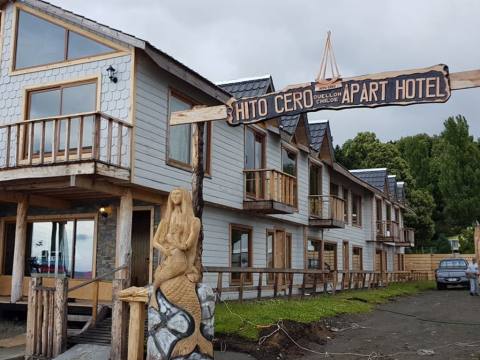
At the southern tip of Chiloé, Quellón marks the end of the Pan-American Highway. The Hito Cero (Milestone Zero) stands at Punta de Lapas beach resort, which has a 5 km beach. 22 km away, Auchac has a long beach, rocky shores and forest.
When to go
Summer is beach season: in Los Molinos, from 15 December to 15 March. Carelmapu fills up for the Candelaria festival. To see the Puñihuil penguins, check visiting dates in advance.
Getting there
Valdivia, Osorno and Puerto Montt have airports and long-distance buses. Niebla is reached by Route T-350 or by ferry from Corral; the Osorno coast by Route U-40. To reach Chiloé, cross the Chacao Channel and follow the Pan-American Highway to Quellón.